


Forehead Reduction Surgery
Surgical Precision | Natural Results | Doctor-led from start to finish
Change the shape and size of the forehead or remove a badly scarred or transplanted area of scalp
Every consultation is led by our surgeons.
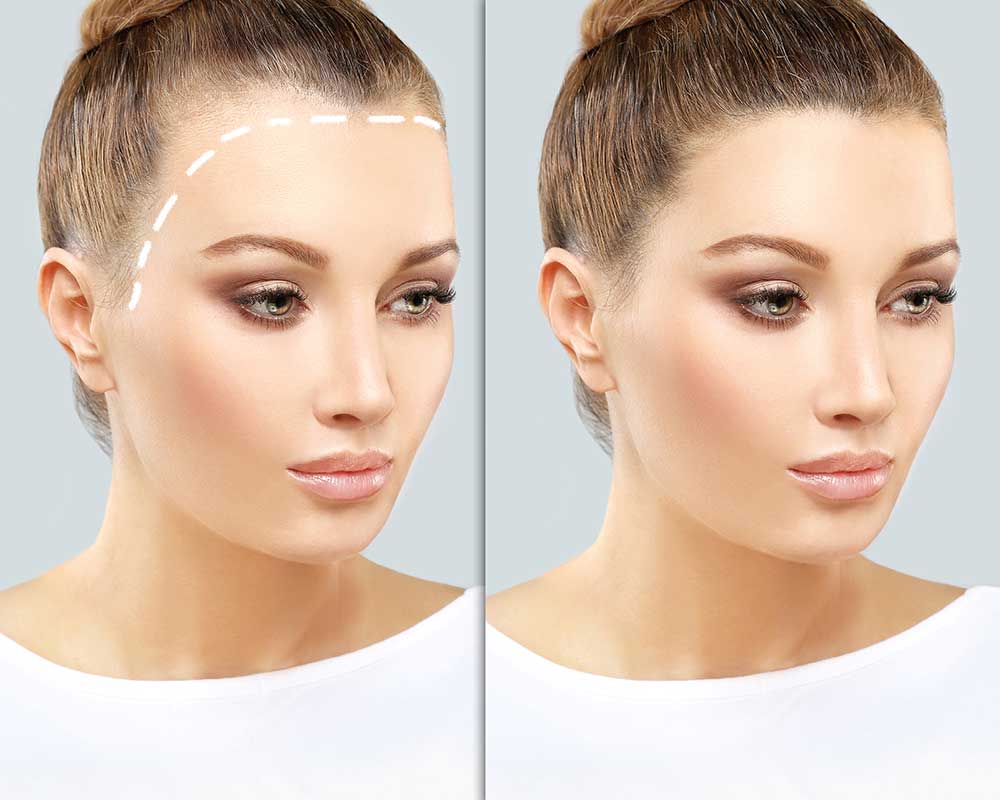
What is forehead reduction surgery?
Forehead reduction or scalp advancement, is a cosmetic procedure to surgically move the hair-bearing scalp forward and reduce the height of the forehead by 1–3 cm. Unlike FUE, this is an advanced surgical procedure involving tissue advancement rather than individual graft placement.
Are you suitable for forehead reduction surgery?
Patients seeking this procedure usually have a naturally high forehead and want to reduce the distance between their eyebrows and their hair. In some instances patients have a scarred or badly transplanted area of scalp they want concealed. The ideal candidate is someone who has had a high forehead or large forehead space since childhood, rather than someone whose hairline is actively receding. They should also have good scalp flexibility, hair density at the front edge where the forehead meets the hairline and no active hair loss.
Women are traditionally the most common candidates for this procedure, as female pattern hair loss rarely affects the frontal hairline in the same way it impacts men.
Men can be suitable candidates only if they have a family history of stable hairlines, show no signs of male pattern baldness, or have completely stabilised their hair loss via medical therapies or a previous hair transplant.
The Process
01
Assessment
A one-to-one consultation with our hair transplant doctor
02
Design
Precise facial marking and mapping to determine the new hairline
03
Procedure
Local anaesthetic with sedation. Surgeon makes micro (trichophytic) incision before repositioning hairline and scalp.
04
Recovery
Patients free to leave after 1-2 hours of recovery.
Elscott Medical Approach
During a consultation, our doctor will physically test how much your scalp moves. If the scalp is exceptionally tight, alternative options like an FUE transplant are usually recommended instead. We are looking for enough natural flexibility for the scalp to be brought forward comfortably and typically between 1.5cm to 3cm.
We use precise facial marking and mapping to ensure the new hairline respects the natural curves of the face.
We will create a natural result by ensuring hairs grow forward through the micro-incision, thus entirely camouflaging any scarring.
The procedure
On the day of the procedure, which is done in a private theatre room under general anaesthetic, we will physically manipulate the scalp to test its final movement (laxity) and meticulously draw the proposed new hairline. We will make a micro-incision right along the transition zone where the forehead meets the hair. This ‘trichophytic’ incision, is an advanced technique where the cut is angled so that native hair follicles grow directly through and over the scar tissue as it heals, rendering it virtually invisible.
To ensure the advanced hairline stays perfectly in place without putting undue tension on the skin surface, we anchor the deep layers of the scalp to underlying tissue or bone using microscopic, bio-absorbable tension devices or deep dissolvable sutures.
Recovery and results
Immediate recovery from the procedure is swift and under our medical supervision; usually 1-2 hours for the patient to come around and settle. After a final post-operative check, patients are discharged home. Because they’ve been sedated, patients will need a pre-arranged companion to drive them home. We schedule follow-up appointments at one week, one month, six months, and twelve months to monitor your progress and provide ongoing guidance.
Get in touch, and let's discuss your needs
A consultation at Elscott begins with what your hair loss is, why it is happening, and what, if anything, is worth doing about it.
Price
£7,500
Anaesthetic
Local anaesthetic with sedation
Procedure time
Approximately 1 hour
Recovery
1-2 hours
Scarring
Minimal, micro-incisions
Suitable for
This surgery is for people with a high forehead
Results
Direct reduction of forehead height
Altered Facial Proportions and Symmetry
Can conceal badly scarred areas of scalp
A concealed incision line
The Elscott Approach
Surgeon performs every step — no technician delegation
Bespoke planning with trichological assessment
We use a ‘trichophytic’ micro-incision technique
Scheduled follow-up over 12+ months
“A surgical forehead reduction requires a micro-surgical closure technique. We use a specialised trichophytic incision, which allows the native hair follicles to grow directly through the healed scar line. This ensures the final result is exceptionally discreet, flat, and virtually undetectable.”
Dr Adrian Scott
Co-Founder & Hair Transplant Surgeon, Elscott Medical
Frequently Asked Questions
The surgical incision is made along the front edge of your hairline, meaning it is technically located on the border of the face. However, our surgeons utilise an advanced method called trichophytic incision. By angling the surgical blade precisely across the hair shafts, the native hair follicles just below the surface are left intact.
As you heal, your natural hair actually grows directly through and in front of the microscopic scar tissue. Within a few months, this new hair growth naturally breaks up the line, rendering the incision border virtually undetectable and completely camouflaged by your own hair.
On average, most patients can expect their forehead to be safely reduced by 1.5cm-3cm in a single procedure. The exact distance depends entirely on your individual scalp laxity (how flexible and mobile your scalp tissue is naturally).
While both procedures achieve a lower hairline, they are fundamentally different in timeline, technique, and suitability:
- Hairline Lowering Surgery physically moves the entire existing hair-bearing scalp forward. The results are immediate, meaning you leave the clinic that afternoon with your new forehead proportions already established. It achieves maximum, natural density in a single 2-hour procedure.
- A Hair Transplant (FUE) fills in space by moving individual follicles. It requires no surgical incisions on the forehead, making it better for progressive thinning or tight scalps, but the results take 12 to 18 months to grow in, and it may require multiple sessions to achieve the dense, thick look of a native hairline.
Most patients are pleasantly surprised by how manageable recovery is. Because deep internal anchoring sutures bear all the structural tension of the tissue advancement, there is very little pulling on the skin surface. You will experience a sensation of tightness and mild forehead numbness for the first few weeks, but actual sharp pain is minimal and easily controlled with standard, mild oral medication.
Patients can typically return to desk work and light daily activities within 5 to 7 days post-surgery. Any forehead bruising or minor swelling usually peaks around day 3 or 4 and subsides rapidly. Surface sutures are cleanly removed at the clinic around day 7 to 10.
Prices very depending on the specifics of each case but, in general, Forehead Reduction surgery costs £7,500.
Ready to take your first step?
Every consultation is led by Hala or Adrian — our surgeons who will care for you from first conversation through to follow-up
Hair Knowledge Hub
Female Hair Loss & The Ludwig Scale
We explain the unique biological triggers and diagnostic stages of female hair…
Red Hair – Scottish Genetics and Red Hair Loss
Scotland has the highest global prevalence of the MC1R red hair gene. Discover…
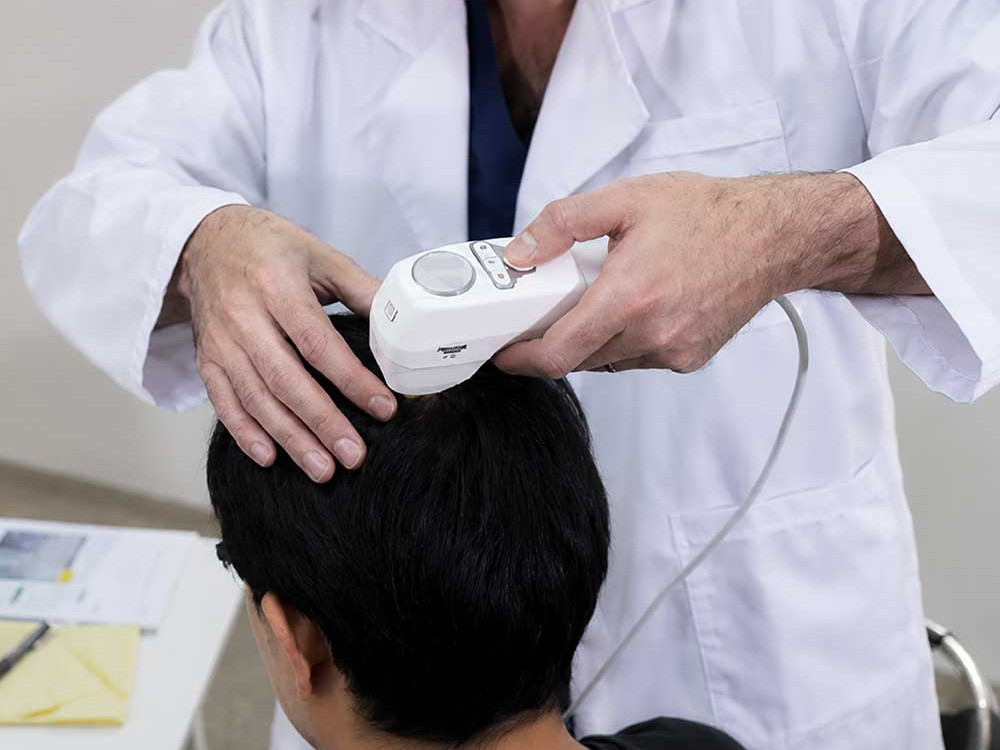
Patient Consultation and Diagnostic Assessment
Your hair regrowth journey at Elscott Medical begins with a doctor-led patient…
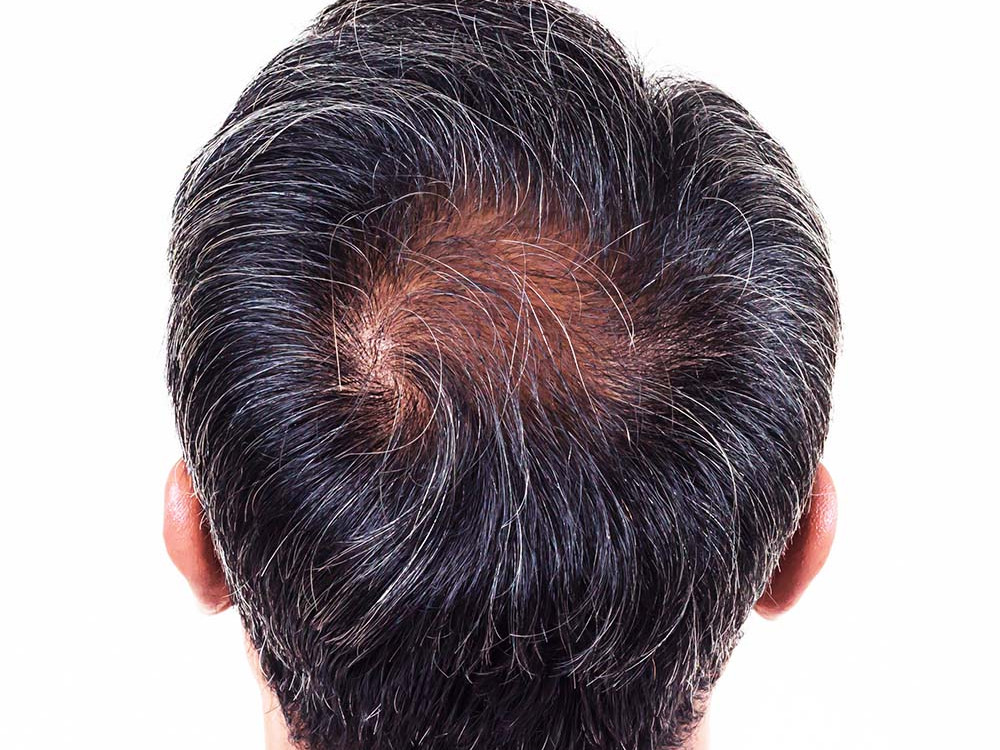
Male Pattern Baldness and The Norwood Scale
Understanding genetic hair thinning, Male Pattern Baldness and the Norwood…